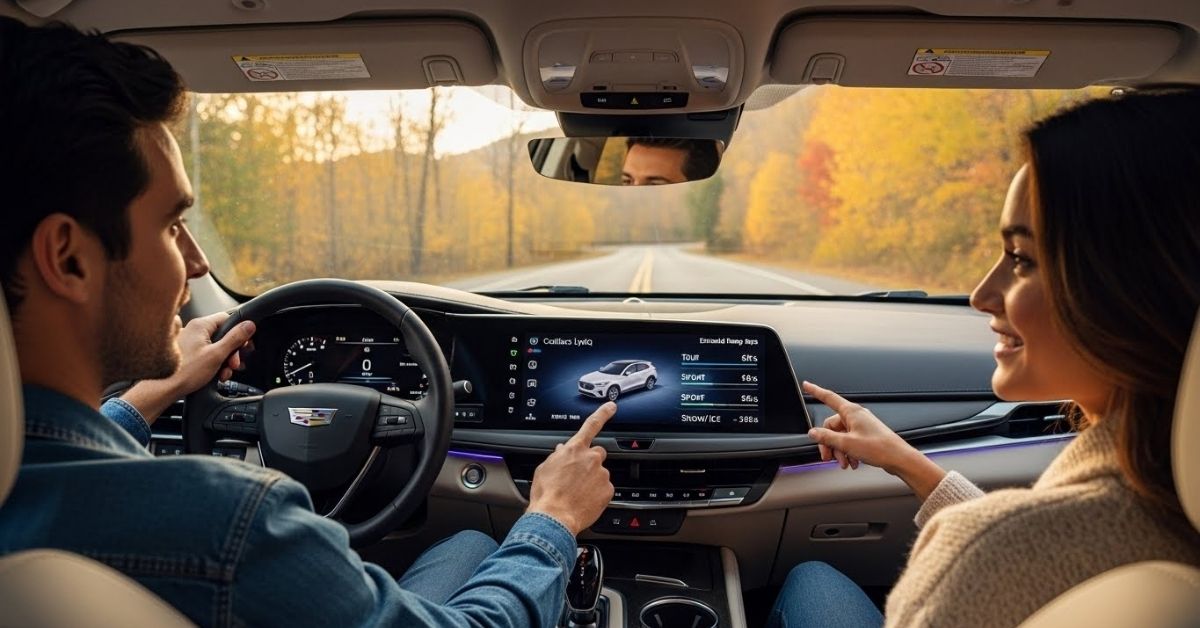

When you slide behind the wheel of a modern electric vehicle like the Cadillac Lyriq, you are not just driving a car; you are managing a sophisticated computer on wheels. One of the most common questions new owners and potential buyers ask revolves around efficiency. Specifically, they want to know if tweaking the settings really matters. Do the driving modes in the Cadillac Lyriq actually change how far you can go on a single charge? The short answer is yes, but the mechanics of how this happens are fascinating and worth exploring in depth. Understanding these modes can transform your driving experience from stressful range anxiety to confident cruising.
Understanding the Heart of the Lyriq
To truly grasp how driving modes affect range, we first need to look at what powers this luxury SUV. The Cadillac Lyriq is built on General Motors’ Ultium battery platform, a system designed for flexibility and power. This battery pack is the fuel tank of the future, but unlike a gas tank that simply drains as you drive, the battery’s depletion rate is highly variable. It depends on how much energy the motors demand, how much is recaptured through braking, and how many accessories like air conditioning or heated seats are running.
The vehicle’s software acts as the brain, constantly making decisions about where to send power. When you select a specific driving mode, you are essentially telling the brain what your priorities are. Are you looking for a thrill? Do you need to navigate a snowy driveway? Or is your main goal to stretch every last electron to reach a distant charging station? Each mode adjusts parameters like throttle response, steering weight, and sometimes even the suspension feel, but the most critical adjustment for our purpose is how the car manages energy consumption.
The Default Experience: Tour Mode
Most drivers will spend the vast majority of their time in Tour mode. This is the baseline setting for the Cadillac Lyriq, designed for everyday comfort and usability. In Tour mode, the vehicle balances performance with efficiency. It does not aggressively limit power, so you still have plenty of passing ability on the highway, but it also does not keep the motors on high alert unnecessarily.
The range you see advertised for the Lyriq is typically based on driving in conditions similar to what Tour mode provides. The accelerator pedal feels linear and predictable. When you press down, you get a smooth delivery of power rather than a sudden jolt. This smoothness is key to battery conservation. Sudden acceleration spikes demand massive amounts of current from the battery, which generates heat and reduces overall efficiency. By smoothing out these inputs, Tour mode helps you drive more efficiently without you even realizing it.
However, Tour mode is not strictly an economy mode. It allows for normal use of climate control and other creature comforts without restriction. If you are driving on a mild day with moderate traffic, Tour mode will likely deliver range figures very close to the EPA estimates. It is the goldilocks zone for the Lyriq—not too aggressive, not too sluggish, just right for the daily commute or the school run.
Prioritizing Thrills: Sport Mode
Switching the dial to Sport mode changes the personality of the Lyriq significantly. The steering tightens up, giving you more feedback from the road, and the accelerator becomes much more sensitive. A small tap on the pedal results in a surge of torque. While this makes the car feel lighter and faster, it comes at a cost. That cost is paid in electrons.
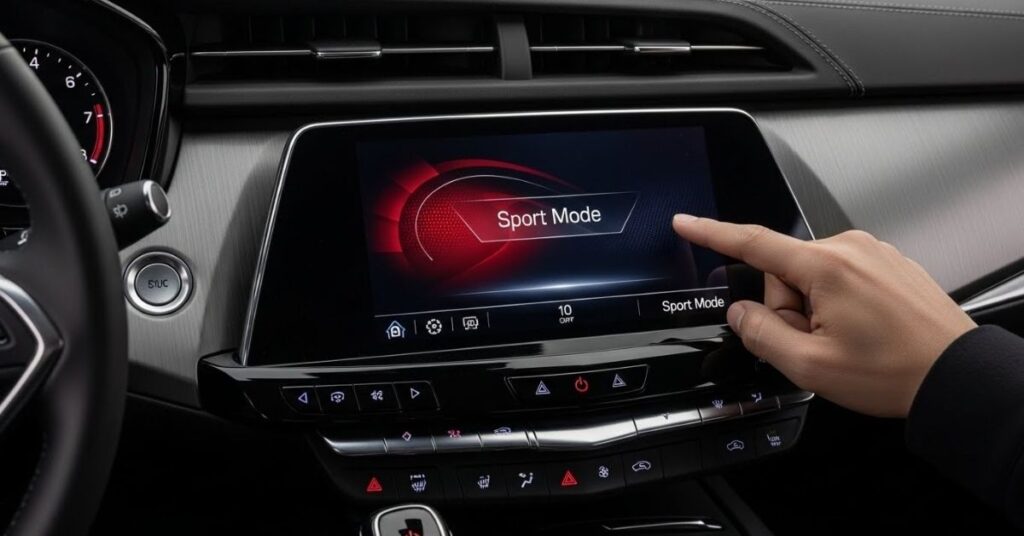
In Sport mode, the vehicle is primed to give you maximum power instantly. This means the battery management system allows for higher discharge rates. Frequent bursts of acceleration, which Sport mode encourages, are the enemy of range. Every time you launch from a stoplight or accelerate hard out of a corner, you are draining the battery faster than in Tour mode.
It is not just the acceleration that impacts range here. Sport mode often encourages a more aggressive driving style overall. Drivers tend to brake later and harder, which can sometimes bypass the regenerative braking system and engage the physical friction brakes. When you use the friction brakes, that energy is lost as heat rather than being sent back into the battery. So, while the mode itself changes the car’s mapping, the biggest impact on range often comes from the driver’s behavior change that the mode inspires. If you drive gently in Sport mode, the range penalty might be minimal, but very few people choose Sport mode to drive gently.
Navigating the Elements: Snow and Ice Mode
The Snow and Ice mode is designed for traction and stability rather than speed or efficiency. In this setting, the accelerator pedal becomes much less sensitive. You have to press it further to get the car moving. This dampening effect is intentional to prevent the wheels from spinning on slippery surfaces, but it has an interesting side effect on efficiency.
Because the throttle response is so gradual, it naturally prevents the kind of jackrabbit starts that kill battery range. In theory, this could make it a very efficient mode. However, the conditions that require Snow and Ice mode are usually the real range killers. Cold weather is notoriously bad for electric vehicle batteries. Chemical reactions inside the battery slow down, reducing its capacity, and the need for cabin heating draws significant power.
While the driving mode itself adjusts the torque distribution to ensure all four wheels (in AWD models) are working together to keep you on the road, the battery usage is often higher simply because of the environment. The vehicle might also engage the motors differently to maintain traction, using energy to prevent slip rather than propel the car forward. So, while the throttle mapping is conservative, do not expect record-breaking range numbers when using this mode, mostly due to the external factors usually present when you need it.
The Ultimate Efficiency Tool: My Mode and One-Pedal Driving
While not a traditional “Eco” mode in the sense of a single button press, the Lyriq offers customizable settings often grouped under “My Mode,” and features like One-Pedal Driving that profoundly impact range. One-Pedal Driving is perhaps the most significant feature for anyone looking to maximize their distance.
When this feature is active, lifting your foot off the accelerator engages strong regenerative braking. The electric motors turn into generators, slowing the car down and sending energy back into the battery. You can often bring the car to a complete stop without ever touching the brake pedal. This captures kinetic energy that would otherwise be wasted.
The intensity of this regeneration can often be adjusted. On its highest setting, you can recapture a surprising amount of energy, especially in stop-and-go city traffic. This is where electric vehicles shine. Unlike gas cars that burn fuel while idling and waste momentum braking for every red light, the Lyriq recovers energy. Using high regeneration settings essentially extends your fuel tank while you drive. Many drivers find that once they get used to the rhythm of one-pedal driving, they can exceed the rated range estimates in urban environments.
How the Climate System Plays a Role
It is impossible to talk about battery usage without mentioning the climate control system, which operates somewhat independently of the driving modes but is crucial to the overall equation. The Lyriq, like many modern EVs, uses a heat pump system which is far more efficient than traditional resistive heating. However, heating or cooling a large cabin still takes energy.
Some driving modes in other vehicles automatically throttle the climate control to save power. In the Lyriq, you often have to make these decisions manually or through specific eco-settings within the infotainment menus. If you are in Tour mode but have the heat blasting and the seat warmers on high, your range will suffer regardless of how gentle you are with the pedal.
Conversely, if you are in a more aggressive mode but keep the climate control moderate, you might mitigate some of the consumption. The interplay between how you drive and how you manage the cabin environment creates the final range figure you see on the dashboard. Smart drivers learn to pre-condition their car while it is still plugged into the charger. By heating or cooling the cabin using grid electricity before you leave, you save the battery’s energy for driving, effectively boosting your range regardless of which mode you select.
The Psychology of the Range Estimate
One fascinating aspect of the Lyriq’s interface is the range estimator, sometimes called the “Guess-O-Meter” by EV enthusiasts. This number is not a static calculation based on the battery percentage. It is a dynamic prediction based on your recent driving history, the outside temperature, and yes, the driving mode you are currently using.
If you have been driving aggressively in Sport mode for the last twenty miles, the car’s computer assumes you will continue to do so. The estimated range will drop faster than the actual miles you are covering. If you switch back to Tour mode and settle into a steady cruise on the highway, you might see that range estimate stabilize or even creep back up as the computer recalculates based on your new, more efficient consumption rate.
This psychological feedback loop is important. It teaches the driver how their inputs affect the car. Seeing the range drop rapidly in Sport mode serves as a gentle reminder that performance has a price. Watching it level out when you engage cruise control in Tour mode reinforces efficient habits. The car is constantly communicating with you about battery usage, helping you learn how to extract the most miles from the pack.
Real-World Scenarios and Expectations
Let us imagine a few real-world scenarios to put this into perspective. Imagine you are planning a long road trip on the highway. In this scenario, the differences between driving modes become less pronounced because you are maintaining a constant speed. The aerodynamic drag is the biggest enemy here, not acceleration. However, keeping the car in Tour mode is still advisable because it provides the most comfortable suspension settings for long hours in the saddle.
Now picture a commute through heavy downtown traffic. This is where driving modes and settings like One-Pedal Driving make a massive difference. In Sport mode, the jerky acceleration would be uncomfortable and inefficient. In Tour mode with high regeneration enabled, you can glide smoothly between lights, recapturing energy at every stop. The difference in battery usage between these two approaches over a week of commuting can be significant, potentially saving you a charging session.
For those rare occasions when you find yourself on a winding back road, Sport mode offers enjoyment that justifies the extra energy consumption. The key is knowing that you are making a trade-off. You are trading range for engagement. As long as you have enough charge to get to your destination or the next charger, that is a perfectly valid choice to make. The Lyriq gives you the option to choose your experience, and by extension, choose your consumption rate.
The Future of Software Updates
Another critical thing to remember about modern vehicles like the Lyriq is that they are not static. General Motors can, and likely will, send over-the-air software updates that could tweak how these driving modes function. They might refine the torque curve in Tour mode to squeeze out a few more percentage points of efficiency. They could adjust the thermal management strategy in Sport mode to allow for longer periods of high performance without overheating.
This means the answer to our question is somewhat fluid. What is true today regarding the exact difference in range might change slightly with a future update. However, the fundamental physics will remain the same. Aggressive driving requires more energy. Smooth driving requires less. The driving modes are simply tools that help you achieve one or the other more easily. Keeping your vehicle’s software up to date ensures you are always getting the best possible balance of performance and efficiency that the engineers have developed.
Battery Health and Long-Term Usage
Does driving exclusively in Sport mode hurt the battery long-term? This is a common worry. Generally speaking, the battery management system is designed to protect the cells from damage. It will not allow you to draw more power than is safe. However, consistently driving in a way that generates high heat—like constant aggressive acceleration—does put more stress on the battery pack over time than gentle driving.
While the degradation might be negligible for most owners, those who prioritize longevity might want to stick to Tour mode for the majority of their miles. It is a gentler cycle for the battery chemistry. The Lyriq is built to be durable, but like any machine, treating it with a bit of mechanical sympathy usually pays off in the long run. The driving modes essentially allow you to choose the level of stress you place on the powertrain components.
Conclusion
Ultimately, the driving modes in the Cadillac Lyriq do offer different ranges and battery usages, but they do so primarily by influencing driver behavior and vehicle responsiveness. The car does not magically become more aerodynamic in Tour mode, nor does the battery grow larger. Instead, the software shapes the power delivery to either sip or gulp energy based on your request.
Understanding these nuances empowers you as a driver. You are not a passive passenger hoping you make it to the next charger. You are an active participant in the energy management of the vehicle. By selecting the right mode for the right situation—Tour for the highway, One-Pedal Driving for the city, and Sport for the fun roads—you can optimize the Lyriq’s performance to suit your needs perfectly. You can maximize range when it counts and enjoy the impressive power of the electric drivetrain when efficiency is less of a concern. This flexibility is one of the greatest advantages of the electric era, giving you multiple cars in one sleek package.
Frequently Asked Questions
Does Sport mode always use more battery than Tour mode?
Generally, yes. Sport mode sharpens throttle response, which encourages quicker acceleration and higher energy consumption. However, if driven extremely gently at a constant speed, the difference might be negligible on the highway.
Can I increase my range by using One-Pedal Driving?
Yes, significantly. One-Pedal Driving maximizes regenerative braking, which captures energy normally lost during deceleration and sends it back to the battery, especially effective in city traffic.
Does the Snow/Ice mode save battery since it is slower?
Not necessarily. While it dampens acceleration which can save power, this mode is typically used in cold weather or poor conditions where battery efficiency is already reduced due to temperature and heating demands.
Does the Lyriq have a specific “Eco” mode?
The Lyriq does not typically have a dedicated button labeled “Eco.” Instead, Tour mode serves as the efficient default, and features like One-Pedal Driving can be engaged to maximize efficiency further.
Do software updates change how driving modes affect range?
They can. Over-the-air updates allow the manufacturer to refine how the motors and battery management system operate, potentially improving efficiency or performance in existing driving modes.
Is it bad for the battery to drive in Sport mode all the time?
The car’s management system protects the battery from immediate damage, but frequent high-power discharge and the resulting heat from aggressive driving can contribute to slightly faster wear over the vehicle’s entire lifespan.